
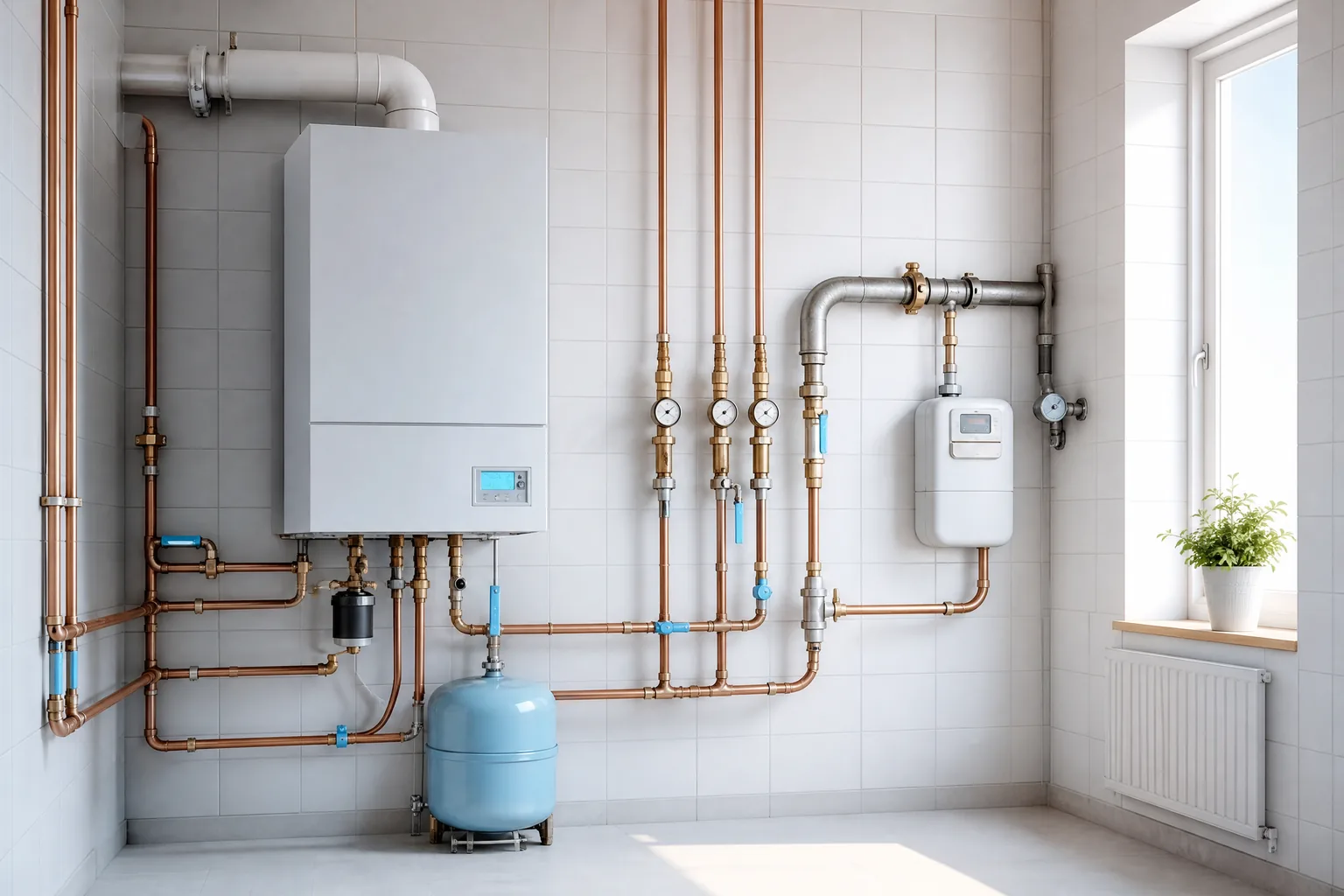
Business gas (Gewerbegas) is natural gas that a company buys for heating, hot water, cooking or production – and because there is no statutory standard tariff for it, comparing offers almost always pays off. Many restaurants, hotels and workshops have paid the same price for years without knowing whether it still matches the market. This guide shows how to estimate your gas consumption in kWh, which price components an offer contains, what the 2026 CO₂ price means and when it makes sense to buy electricity and gas from the same supplier.
Key points at a glance
- Gas for businesses is almost always billed in kilowatt hours. You will find your consumption in kWh on your last annual bill – or you can convert it from cubic metres yourself.
- An offer consists of the unit price (Arbeitspreis), the standing charge (Grundpreis), network charges, taxes, levies and the CO₂ price. Only the annual total for your consumption is comparable.
- In 2026 the CO₂ price is auctioned for the first time, within a corridor of 55 to 65 euros per tonne of CO₂.
- Fixed price or market-linked price: wholesale gas prices fluctuate strongly, so the question of predictability matters especially for gas.
- Electricity and gas from the same supplier can save effort, but they are not automatically cheaper. Calculate both contracts separately and together.
What is business gas and who does it apply to?
Business gas is not a separate product but a natural gas supply contract signed by a company instead of a household. Businesses use gas, for example, in restaurants and takeaways for stoves and fryers, in hotels for heating and hot water, in saunas for the relaxation areas, or in property management companies (Hausverwaltungen) for the central heating of an apartment building.
Legally, the dividing line is not the industry but consumption. Under Section 3 of the Energy Industry Act (EnWG), a business that uses no more than 10,000 kWh a year for commercial purposes still counts as a household customer. Anyone who uses more – as almost every restaurant with gas stove and gas heating does – is a non-household customer. Many protective rules for private customers then no longer apply, and suppliers set their terms more freely.
A second threshold concerns metering. The Federal Network Agency (Bundesnetzagentur) groups household and business customers with an annual consumption of up to 1.5 million kWh as standard load profile (SLP) customers (Bundesnetzagentur: gas consumption of SLP customers). Above that, consumption is usually metered hourly. So for most small and medium-sized businesses in Moers and Duisburg, the standard load profile applies.
How do you estimate your business's gas consumption in kWh?
The easiest way is to read your annual consumption in kWh directly from your last annual bill. The gas meter itself, however, measures cubic metres, and only the network operator converts them into kilowatt hours. With only meter readings, you can do the conversion yourself.
The formula is: cubic metres × calorific value (Brennwert) × conversion factor (Zustandszahl) = kilowatt hours. The calorific value tells you how much energy a cubic metre of gas contains. The conversion factor adjusts for pressure and temperature at your location. Both values are printed on your gas bill. If they are missing, a factor of 10 is enough for a rough estimate: 3,000 cubic metres then become around 30,000 kWh.
How high consumption is depends heavily on use. A takeaway that only cooks with gas uses far less than a hotel that produces heating and hot water with gas. What matters is your own figure, not an industry average. Important: use a full twelve-month period if you can, because businesses with gas heating use many times more gas in winter than in summer.
What makes up the price of gas?
The gas price for businesses consists of a unit price per kWh, a fixed standing charge, network charges, energy tax, concession fee (Konzessionsabgabe), the CO₂ price and VAT. Some of these are set by law or by region; only some are actually negotiated between suppliers.
| Component | What it means | Negotiable? |
|---|---|---|
| Unit price (Arbeitspreis) | Price per kWh consumed; the biggest lever when consumption is high | yes, depending on the supplier |
| Standing charge (Grundpreis) | Fixed amount per month or year, regardless of consumption | yes, depending on the supplier |
| Network charges | Cost of using the local gas network | no, set regionally |
| Energy tax and concession fee | Statutory or municipal charges per kWh | no |
| CO₂ price | Surcharge under the Fuel Emissions Trading Act | no, only the way it is passed on differs |
| VAT | 19 percent on the total; a pass-through item for businesses entitled to deduct input tax | no |
A common mistake when comparing: one offer quotes a low unit price but lists network charges or the CO₂ price separately, while another offer includes everything. So always check whether prices are quoted "including" or "excluding" the levies. Only when both offers contain the same items is the annual total comparable.
What does the 2026 CO₂ price mean for your gas bill?
The CO₂ price makes every kilowatt hour of natural gas more expensive, and in 2026 it is set on the exchange for the first time instead of as a fixed value. The German Environment Agency (Umweltbundesamt) reports that certificates in national emissions trading are auctioned for the first time in 2026, within a price corridor of 55 to 65 euros per tonne of CO₂ (Umweltbundesamt: first auctions in national emissions trading).
The legal basis is the Fuel Emissions Trading Act (BEHG on gesetze-im-internet.de). It is not your business that buys the certificates but the gas supplier that places the fuel on the market. The supplier passes the cost on to you through the gas price – some in the unit price, others as a separate line on the bill.
For your comparison this means two things. First, ask for every offer whether the CO₂ price is included and how it changes if the certificate price rises. Second, from 2027 national trading is due to move into European emissions trading for fuels. How the price will develop then cannot be reliably predicted today. A longer contract should therefore state clearly who bears this risk. (As of: October 2026)
Fixed price or market-linked – which pricing model suits gas?
A fixed price suits businesses that want to know their gas costs for the whole term; a market-linked price suits businesses that can absorb fluctuations in their budget. With gas, this decision is often more important than with electricity, because wholesale natural gas prices have fluctuated particularly strongly in recent years.
With a fixed price, the unit price is locked in for the contract term. Pay attention to what exactly is "fixed": the guarantee often covers only the energy price, while network charges, taxes and the CO₂ price may be adjusted. With the market-linked model, the price is fully or partly tied to the wholesale market. If prices fall, you benefit immediately; if they rise, your bill rises too.
An example from hospitality: a restaurant with a gas stove and gas heating has its highest consumption in winter – exactly when market prices often climb. For a business like this, predictability is usually worth more than a possible saving. A hotel with its own building services and staff for energy management, on the other hand, can more easily work with a market-linked share.
Does it pay to buy electricity and gas from the same supplier?
Electricity and gas from one source pay off mainly when you want to save admin work and manage both contracts on the same date. A bundled contract is not automatically cheaper – sometimes a supplier is strong on electricity and expensive on gas.
The biggest practical advantage is synchronised terms. When both contracts end at the same time, you compare once, decide once and do not miss a notice period. How to weigh the differences between standard load profile and power metering, fixed price and market price for electricity is explained in our guide to comparing business electricity for companies. For a fair comparison, calculate both contracts once separately and once as a package; only then will you see whether bundling actually brings anything.
How does a business gas comparison work step by step?
A business gas comparison needs only a few documents, and preparation usually takes the business less than an hour. The actual work – obtaining offers, checking them and handling the switch – can be taken over by an adviser.
- Find your annual bill: it shows annual consumption in kWh, meter number, market location ID (Marktlokations-ID) and your current supplier.
- Check your contract details: note the end of the term, the notice period and whether the contract renews automatically.
- Assess your consumption: has the business changed, for example with a new kitchen, an expansion or a heat pump? Then expected consumption counts, not the old figure.
- Put offers on the same basis: same consumption, same term, same items including network charges and CO₂ price.
- Choose a pricing model: fixed price, market-linked or a mix – whatever fits your budget.
- Order the switch: the new supplier usually cancels the old contract and registers the switch with the network operator. Supply continues without interruption.
For businesses in Moers, Duisburg and the Lower Rhine region (Niederrhein), we are happy to take care of these steps. You can find out what we do for businesses on our page on energy advice for business customers.
What do businesses most often ask about business gas?
From what consumption does my business count as a commercial customer?
Legally, from more than 10,000 kWh a year for commercial purposes. Below that, you still count as a household customer under the EnWG. Many suppliers, however, also offer business tariffs to smaller businesses.
Will the gas supply be interrupted when I switch?
No. The switch only changes the contracting party. Gas keeps flowing through the same network and the same meter, operated by the local network operator.
Is the CO₂ price already included in every offer?
Not always. Some suppliers include it in the unit price, others show it separately. Ask, so that you do not compare incomplete prices.
Can I switch gas and electricity at different times?
Yes. The two contracts are independent of each other. It still makes sense to align the terms over time so that you can review both contracts together.
How does Connected Mobile help with your business gas comparison?
We obtain offers for your business, put them on a comparable basis and handle cancellation and registration. Connected Mobile advises business customers in person in Moers and Duisburg, in German, Turkish, Kurdish or Arabic; according to our own figures, our team has more than 15 years of experience in the energy sector. If you would like to review electricity and gas together, we will look at both contracts. You can find an overview of our services for businesses under business electricity and business gas for companies.
How much you can save depends on your contract, your consumption and the market – we only know once we have seen your figures. Bring your last gas bill to our shop in Moers or Duisburg or send it via WhatsApp, and we will work out for you whether switching pays off.